Learning Approach
WHICH CURRICULUM DOES MONTESSORI FOLLOW?
Montessori education doesn't adhere to a fixed curriculum in the conventional sense. It's personalised, with learning driven by each child's interests and pace. Following a set syllabus would limit teachers' flexibility to tailor learning experiences to individual needs.
In contrast to traditional schooling where all students learn the same subject simultaneously, Montessori's approach allows for diverse learning paths.
However, if we define curriculum as a framework of goals and values leading to successful learning experiences, Montessori does follow a curriculum. Teachers have clear objectives, guided by materials and experiences prepared for each child.


While Montessori schools globally share a core curriculum and similar teaching methods, the curriculum is meticulously structured, with materials sequenced hierarchically and interconnected across subjects. This integrated approach fosters curiosity and deep learning experiences.
Montessori teachers are trained in similar methods for presenting materials, often using albums as a resource to guide their goals and objectives for each student. These albums contain presentations tailored to specific age groups.
The Montessori curriculum is comprehensive and interconnected, covering subjects like math, science, history, geography, and language through an integrated approach.
This approach fosters curiosity and allows students to become thoroughly immersed in a topic, demonstrating the interrelatedness of all things.
Fælles mål
Holistic Development
The Fælles Mål emphasize both academic competencies and social skills, including collaboration, communication, and responsibility.
Montessori pedagogy also prioritizes holistic development, fostering independence, social responsibility, and emotional growth alongside academic learning.
Competency-Based Learning
The Danish system uses competency-based objectives (e.g., in Danish and Math) that mirror Montessori’s emphasis on achieving mastery at an individualised pace. Both systems recognise that different children may progress at different speeds.
Interdisciplinary Approach
Many aspects of the Fælles Mål encourage connections between subjects (e.g., science, history, and geography), which aligns well with Montessori's cosmic education approach, where subjects are interconnected and taught through broad, thematic lessons.
DANISH FÆLLES MÅL & INTERNATIONAL MONTESSORI SCHOOL
Individualized Learning
While the Fælles Mål provide a standardized framework, schools have flexibility in delivery, allowing Montessori schools to meet the objectives through child-led learning and individual work plans.
Hands-On Learning
Both frameworks value experiential learning. Montessori's use of tactile materials and real-world applications aligns with the Fælles Mål emphasis on practical and project-based learning, especially in science and mathematics.
Cultural and Democratic Values
Danish schools focus on fostering democracy, empathy, and inclusivity, core elements of Montessori education, which encourages respect for others and the environment.
While there are significant overlaps, some differences exist:
KEY DIFFERENCES
Structured vs. Flexible Framework
Structured vs. Flexible Framework: The Fælles Mål provide structured, grade-specific guidelines detailing what students must achieve at each level. In contrast, Montessori education focuses on developmental stages, allowing children to progress at their own pace rather than being confined to grade-level benchmarks. However, experience demonstrates that when Montessori is implemented with fidelity to its pedagogy, children often surpass the expectations outlined in grade-specific frameworks, achieving a much broader and deeper understanding of the material by the end of their developmental cycle.
Assessment
In Danish schools, formal evaluations are typically used to assess student outcomes. In contrast, Montessori schools emphasize continuous observation, detailed portfolios, and individualized progress tracking. At our school, every lesson and each child's progress are meticulously documented weekly in the Montessori Compass system. This approach ensures that our teachers have a precise understanding of where each student is in their development and what their next steps should be. Additionally, parents, the teaching team, and our school inspector can easily access and monitor each child's progression, providing full transparency and ensuring alignment with both Montessori principles and broader educational standards.
How Montessori Aligns Practically with Fælles Mål

Mapping Montessori Lessons to Competencies
Montessori materials and lessons are mapped to specific competencies outlined in the Fælles Mål, ensuring students meet the prescribed objectives while enjoying the benefits of a child-centered, developmental approach.
Interdisciplinary Projects
Many objectives in subjects such as history, geography, and natural sciences can be covered through interdisciplinary projects that reflect real-world connections, a hallmark of Montessori pedagogy.
Individual Progress Documentation
Our Montessori school uses tools like Montessori Compass to track individual progress weekly. This meticulous documentation allows teachers to evaluate each child’s development against the learning outcomes, ensuring they meet or exceed expectations.
Examples of Alignment
Danish language
While our Danish lessons follow a practical, non-Montessori approach, broader language objectives in areas like grammar, sentence construction, and creative writing are seamlessly integrated into Montessori language materials for English. These materials provide a solid foundation for mastering linguistic structures.

Math
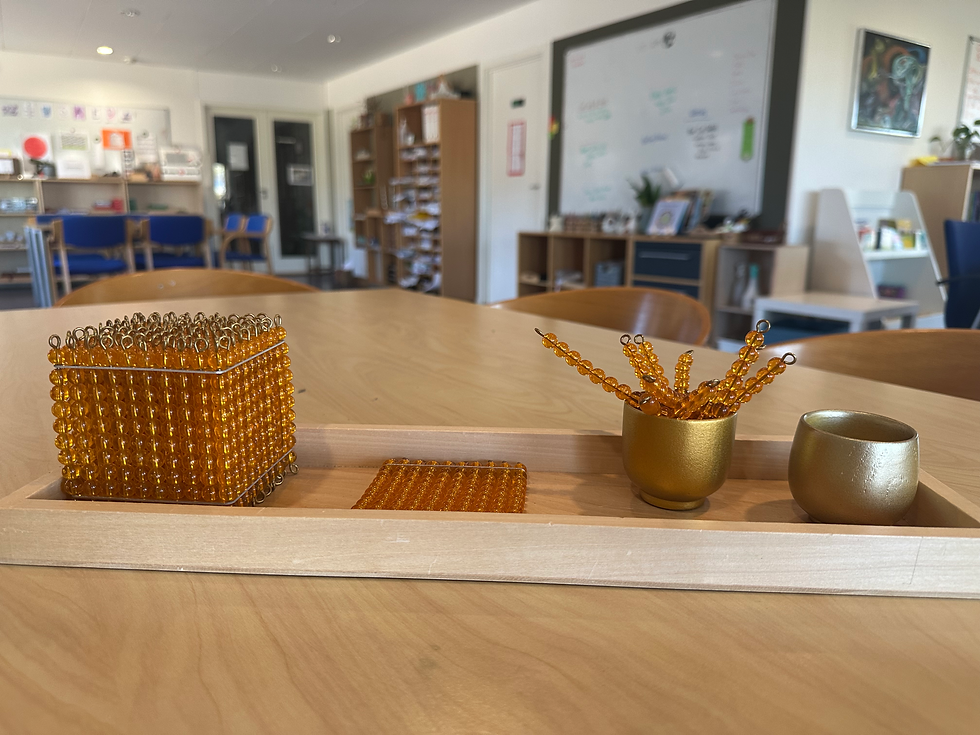
Montessori math materials, such as golden beads for place value and operations, and fraction circles for understanding parts of a whole, inherently align with Fælles Mål objectives, offering both a tactile and conceptual grasp of mathematical concepts.